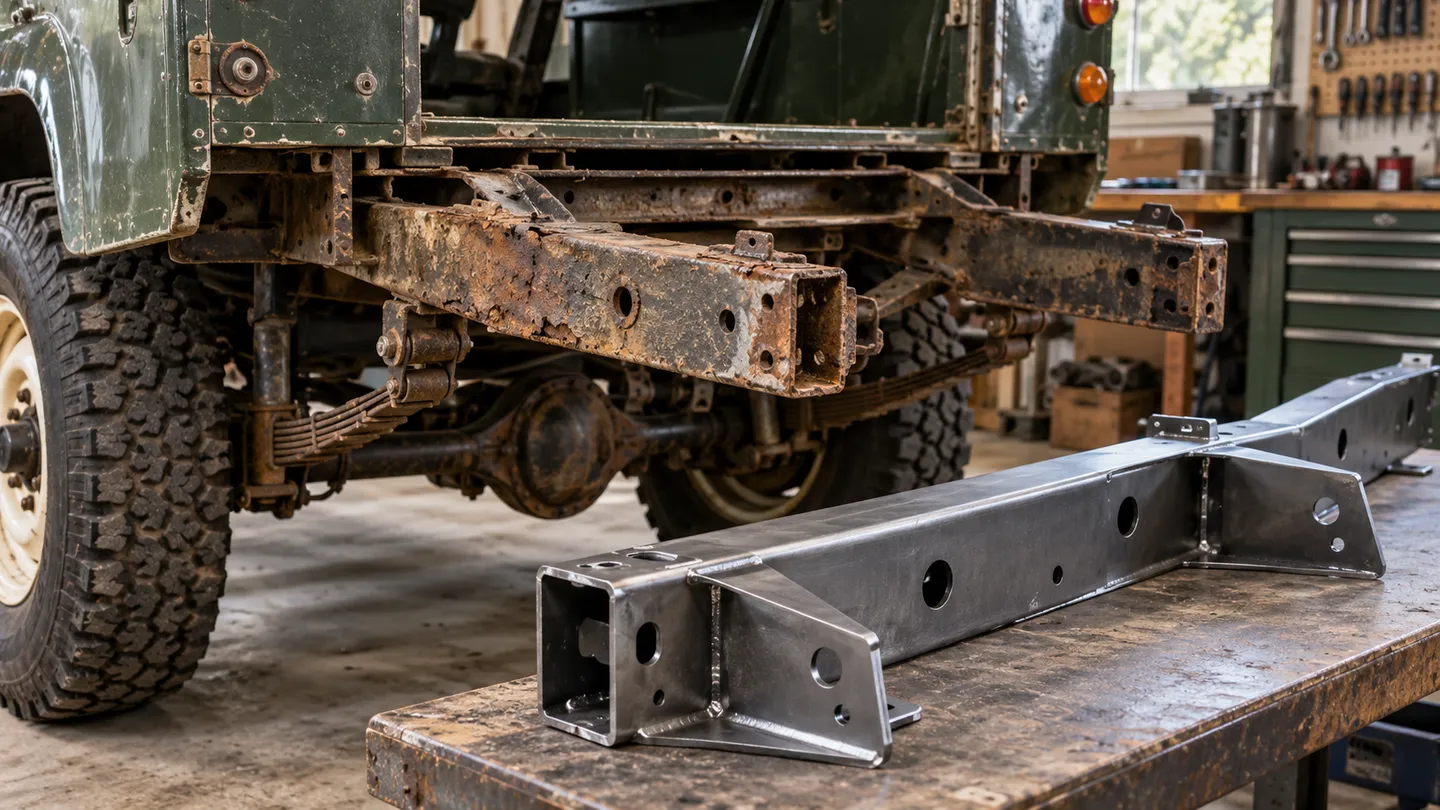
A corrosion failure on a Defender, Series Land Rover or older Discovery can leave you with a difficult decision: repair the affected area, investigate further, or discuss a replacement chassis.
The MOT report is a starting point. It does not describe every hidden surface or tell you how much metal a repairer will need to remove. A useful quote starts with the report, the vehicle details and an assessment of the surrounding structure.
Start here: ask what has failed, how far the corrosion extends, and whether the proposed work restores a sound structure. A fresh coat of paint is not evidence of a suitable repair.
What an MOT corrosion failure means
The DVSA manual assesses corrosion by location and structural effect. Prescribed areas include supporting structure within 30 cm of specified testable-item mountings. The tester uses visual checks, hand pressure and, where needed, careful scraping or light tapping with the approved assessment tool—not heavy poking with a screwdriver.
Structural repairs must extend into sound material and appear as strong as the original structure. Patch repairs generally need a continuous seam weld; the manual also describes exceptions for original spot-welded construction and manufacturer repair methods. Highly stressed components have additional restrictions.
Read the DVSA structural integrity and corrosion guidance for the applicable inspection criteria. No proposed repair guarantees a pass.
Why hidden corrosion matters
A ladder chassis has enclosed sections, joints and mounting points that can be difficult to inspect. Moisture, road debris and older coatings can make the extent of corrosion harder to judge from the outside.
Cleaning and access may reveal more work than photographs suggest. Ask the repairer how they will assess the surrounding metal and whether further discoveries could change the quote.
On a vehicle with aluminium body panels and steel components, joints between different materials also deserve attention. The assessment should distinguish chassis damage, body mounting issues and bulkhead work rather than treating them as one identical job.
Five areas to discuss with the repairer
These are useful areas to ask about, rather than a ranked list or a claim that every Land Rover will fail in the same places. The layout varies by model and year.
1. Rear crossmember
Ask about the crossmember, adjoining rails and any relevant towing attachments. Depending on the damage, the conversation may involve a local repair or replacement section. The surrounding structure and access affect the choice.
2. Outriggers and body mounts
These connections locate and support parts of the body. Ask whether the damage is confined to the mounting section or also affects the chassis rail where it joins.
3. Chassis rails
Request an assessment of accessible inner and outer faces, joints and previous repairs. An outside photograph alone cannot show the full condition of an enclosed rail.
4. Bulkhead and footwells
The bulkhead is a separate part of the repair discussion. Access, adjacent panels, mounting points and the amount of dismantling can make its repair quite different from a chassis section.
5. Suspension mounting areas
The relevant mounts differ between leaf-sprung Series vehicles and coil-sprung models. Ask which mounting areas need attention on your particular vehicle and whether replacement rather than welding is appropriate.
Patch repair or replacement section?
The word “patch” does not, on its own, tell you whether a repair is acceptable. What matters is the remaining metal, the repair design, suitable materials, sound attachment and the standard of the completed work.
Ask the repairer to explain:
- The extent of removal: which damaged metal will be cut out or replaced?
- The surrounding structure: how will they establish that the attachment areas are sound?
- The replacement material: how will thickness and profile suit the original construction?
- The joining method: what method is appropriate for this section and any manufacturer guidance?
- Corrosion protection: how will accessible inner surfaces, joints and cavities be treated afterwards?
- Evidence: can the work be photographed before coatings hide it?
A plate over visibly poor metal should prompt questions, but there is no universal price premium or lifespan that applies to every repair. Compare the scope of the work, not just the lowest figure.
Does the welding process matter?
The process needs to suit the material, section, access and repair requirements. MIG, TIG and other methods are tools rather than a guarantee of repair quality.
Discuss steel chassis work separately from aluminium body-panel work. Do not assume that a workshop offering chassis repairs also takes on every thin alloy panel or every vehicle component. Confirm the scope with the repairer before booking.
For an enquiry, see our vehicle welding page and Land Rover parts, bulkhead and chassis page.
When to discuss a replacement chassis
If corrosion is widespread, several areas have already been repaired, or access makes local repairs impractical, it is worth comparing a repair proposal with a replacement-chassis project.
There is no single “one-third of the rails” rule that decides the answer for every vehicle. Ask for an assessment of structural condition, the full scope of dismantling, the suitability of parts and the total project cost.
A galvanised replacement chassis may be part of that discussion. Its suitability, cost and future corrosion protection depend on the vehicle and the proposed work. It is not a promise that the vehicle will need no further attention.
Questions to ask before booking
- Which areas need work, and which need further investigation?
- Does the quote include dismantling, replacement sections and corrosion protection?
- How will additional corrosion discovered during the job be reported and priced?
- Can I see photographs before the repair is painted or coated?
- What completion time is realistic once the vehicle has been assessed?
- What retest arrangements do I need to make with my MOT station?
Keep the MOT report and a written description of the agreed work. If the answers are unclear, ask for clarification before authorising the job.
Frequently asked questions
Can a Land Rover chassis be repaired after an MOT corrosion failure?
A suitable repair may be possible, depending on the damaged area and the remaining structure. Some components have restrictions on welded repairs. Discuss the specific failure with the repairer and MOT station; a quote is not a guarantee of passing.
How much does chassis welding cost?
An assessment is needed before a useful price can be given. Access, dismantling, the extent of corrosion, parts and finishing all affect the scope. Ask for a written quote that explains what is included and how additional work will be agreed.
Is a galvanised chassis worth considering?
It can be worth discussing when extensive repairs are needed or a larger restoration is planned. Compare the complete project with the repair alternative rather than relying on a promised lifespan or resale value.
Can aluminium body panels be repaired at the same time?
Confirm this separately. Aluminium panel work has different material and process requirements from steel chassis work, and availability depends on the workshop and the specific panel.
How long will the work take?
The timescale depends on access, parts, dismantling and what is found during assessment. Ask for a realistic estimate and an update if the scope changes.
Discuss your Land Rover enquiry
Vehicle Welding Services is based in Longridge, West Lothian, serving Central Scotland. Have your model, year, MOT report and a few clear photographs ready when you contact Calum.
Call 07512 561152 or email weldingrepairswestlothian@mail.com to discuss the work available for your vehicle.